





01
Site assessment
We review the property, current conditions, available plans and the project requirements.

Water stays in the piping for direct response when an individual sprinkler operates. We assess the site, confirm the design basis, then handle installation, testing, commissioning and follow-up.

Wet pipe is a direct, widely used arrangement, but the site, hazard, water supply and approved plans still determine whether it is the right fit.
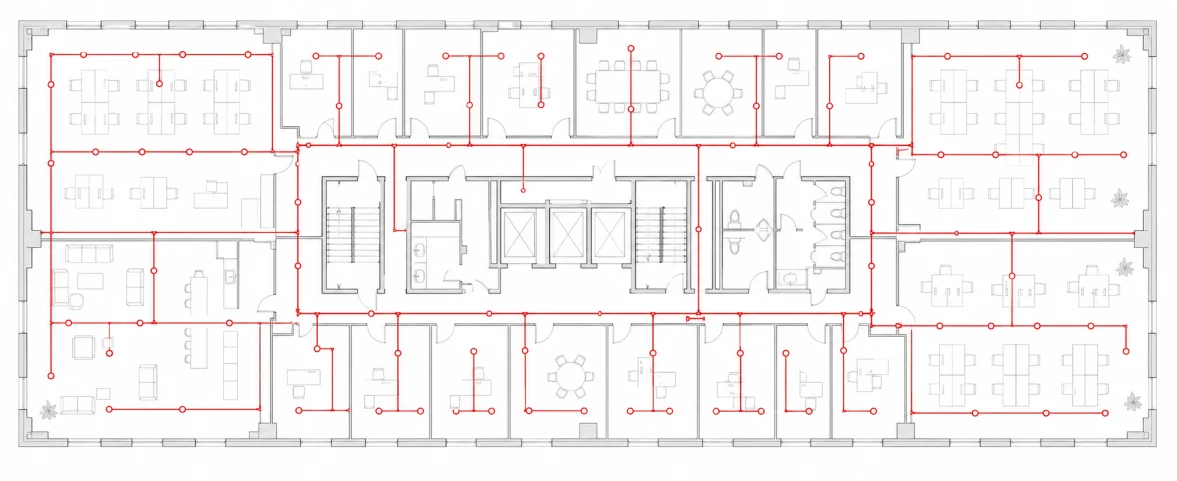
Water remains under pressure in the piping. When heat operates an automatic sprinkler, water discharges from that sprinkler; the others stay closed unless heat reaches them.
Common for offices, warehouses, retail buildings, hotels, factories and other protected areas where a water-filled arrangement suits the approved design and site conditions.
Occupancy and hazard classification, available water supply, hydraulic demand, zoning, pipe routing, alarm and flow interfaces, drainage and approved plans.
We review the site, hazards, water supply and plans before defining the sprinkler-system scope and project sequence.
We review the property, current conditions, available plans and the project requirements.
We define the proposed system, layout, materials and installation scope for review.
We discuss the proposed scope, inclusions, commercial terms and any questions before approval.
Materials, equipment and site work are coordinated against the agreed project scope.
The completed installation is tested and commissioned according to the approved scope.
We remain available to maintain the project documents and BFP-related follow-up within our scope.
We provide preventive maintenance for existing wet pipe sprinkler systems based on the installed arrangement, site condition and agreed service scope.
Review control valves, gauges, piping, sprinklers and visible system conditions.
Perform the agreed waterflow, alarm and valve checks for the installed system.
Record leaks, corrosion, obstruction concerns, damage and corrective work that may be needed.
Provide service records and BFP-related follow-up connected to our scope.
Straight answers about operation, suitable sites, water supply, project information, existing systems and BFP-related support.
It is an automatic sprinkler system with water kept under pressure in the piping. When heat operates a sprinkler, water discharges from that sprinkler onto the affected area.
Normally, no. Automatic sprinklers operate individually when exposed to sufficient heat. Other sprinklers remain closed unless the fire conditions reach them.
It is commonly considered for offices, warehouses, retail buildings, hotels, factories and similar properties. Final suitability depends on the hazard, building conditions, water supply and approved design.
A preaction system may be considered where unintended water admission is a major concern, while selected high-hazard exposures may require deluge protection. The site assessment and approved plans determine the final arrangement.
Yes. We can assess the installed system, review available plans and records, identify the agreed inspection and testing scope, and discuss corrective work when needed.
Send the contact person, company, site location, whether this is a new installation or an existing system, and any available plans, specifications, bill of quantities or BFP comments.
Send the site location, whether this is a new installation or an existing system, and any available plans or specifications. We’ll review the details and contact you about the site assessment and next steps.
Service information and references from DGRB Fire Safety · Updated August 9, 2026 · References: BFP Revised IRR of RA 9514 and NFPA 13 — Installation of Sprinkler Systems.